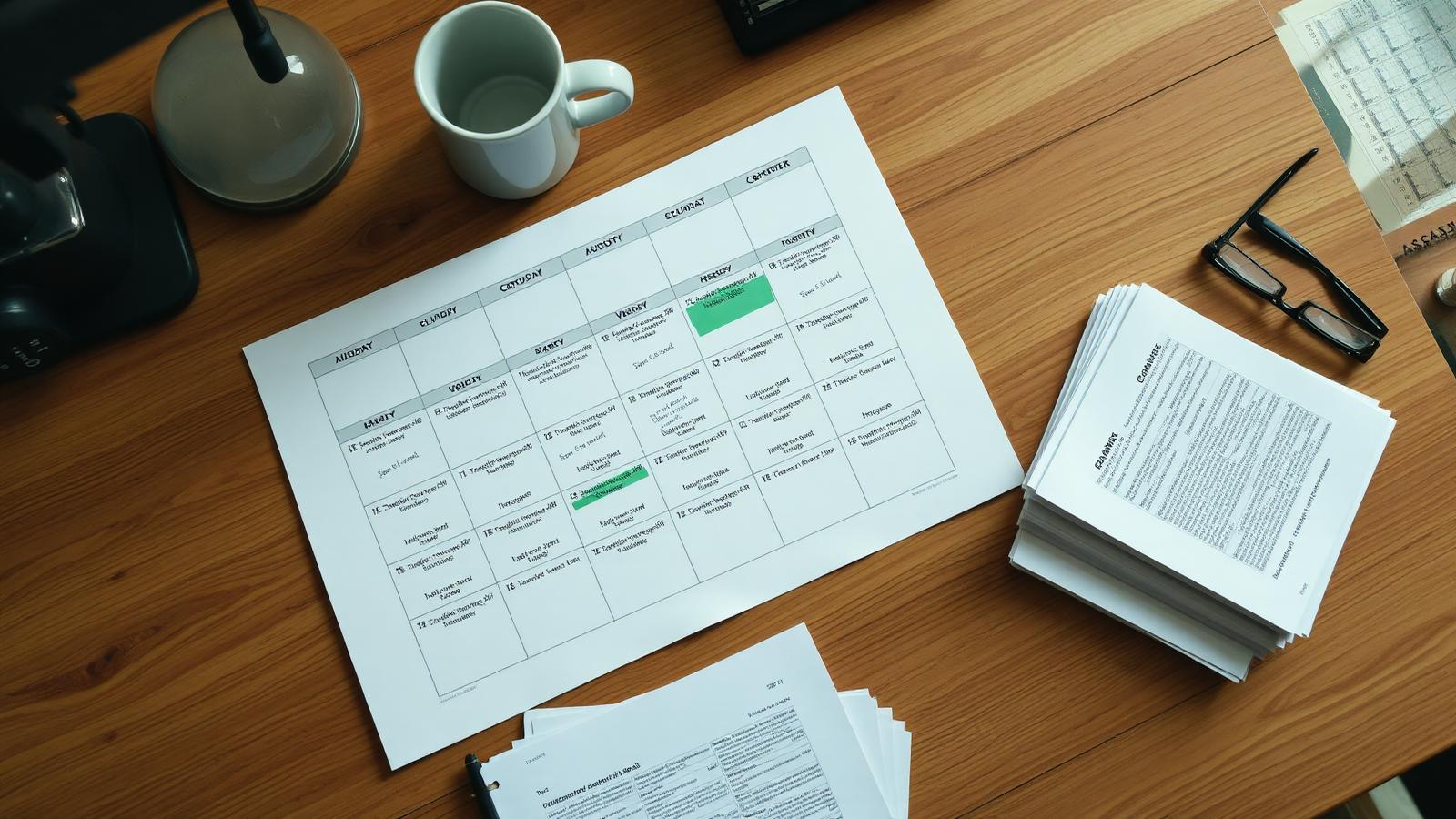
Long-form that reads like someone meant it.
Most B2B content is written to fill a slot, and it shows. Editorial is a system: a calendar tied to your pipeline, angles derived from customer questions, and pieces that earn attention because they contain something worth quoting. Inside every plan from ₹1,49,000/mo, or per article from ₹8,000.
| Wk | Piece | Why now | Who needs it | Status |
|---|---|---|---|---|
| 41 | The end of the content calendar | Reg change, Oct 1 | CFO, board | Approved |
| 43 | Decision latency, measured across 14 deals | Proprietary data | VP Sales, champions | In review |
| 45 | Buyer's guide: six providers compared | RFP season | Procurement | Drafting |
| 47 | What the audit found (flagship refresh) | Quarterly refresh | Answer engines | Briefed |
A calendar tied to authority gaps, not publishing slots.
A topic is not an angle. A keyword is not a position. Every publishing decision has to answer four questions before it earns a place on the calendar, and roughly half of what a team wants to publish fails at least two of them.
The best long-form does two jobs at once. It ranks, and it earns trust from the humans who read it. Both come from the same property: it contains something the reader can carry into the next conversation.
The room you are not in. A buyer cannot repeat a vague idea. A sharp argument travels into the next conversation without you.
Four genuinely good long-form pieces a month beats twelve adequate ones, and it is the tier where most teams first see organic pipeline share move.
Every entry on the calendar answers four questions, or it does not get a slot.
This is the selection step of our method, applied to editorial. The weak answers are the ones most calendars are built on.
| The question | A real answer looks like | A weak answer looks like | What it proves |
|---|---|---|---|
| Why now? | A regulation changed on a known date and nobody has explained the operational consequence. | Competitors are posting about it. | A decision window has opened. |
| Why us? | We hold proprietary transaction data, or we ran the fourteen submissions. | We have a point of view. | The claim can be owned rather than borrowed. |
| Who needs it? | The CFO and the board, who will ask the question in the next cycle. | Prospects at the top of the funnel. | The next room is identifiable by name. |
| What happens next? | Sales opens the follow-up with the finding, then sends the piece. | We add it to the resource hub. | The artifact has a job after publication. |
Roughly half of what a team wants to publish fails at least two of these. Cutting it is the part of the calendar that creates the compounding, because the pieces that remain get the attention that would otherwise have been spread across everything.
One flagship, four satellites, twelve cutdowns. Then refresh.
A cluster is one act of thinking, published at three depths. The angles come from the language buyers actually use, not from a keyword tool.
The language buyers actually use, and the objection they raise before the third meeting, produce more than half the calendar. The rest comes from events with dates and data only you hold. Nothing comes from a keyword list.
Reuse the thinking. Rewrite the experience.
A long-form piece and the three cutdowns that ship with it. Each one native to its surface, each one with a job after publication.
A calendar tied to publishing slots produces volume. A calendar tied to authority gaps produces pipeline. This piece sets out the four questions, the data from 40 editorial programs, and the counterargument from the people who run volume operations…
Contents · The slot problem · The four questions · What 40 programs cut · Where volume is right · Method
Thanks for Thursday. You asked how we would measure the latency problem you described. We published the method last month, with numbers from 14 deals like yours. The relevant table is on page 3.
If it is useful I can walk your team through the data on a 20-minute call.
— R.
| Deliverable | Volume | From which tier |
|---|---|---|
| Editorial calendar on the four questions | Built at onboarding, reviewed on the weekly call. | Voice Standard |
| Placed byline | One long-form a month under your name, interview-backed, in a title buyers read. | Voice Standard |
| Distribution cutdowns | Every long-form piece cut for LinkedIn, sales follow-up and email. | Voice Standard |
| Search and answer-engine briefs | On every piece: queries, entities, sources to cite. | Voice Standard |
| Flagship and company-page long-form | Two a month: a placed byline and a flagship or deep-dive. Website and product content scoped in. | Voice Pro |
| Expert-interview pieces | Four long-form a month, refreshed quarterly, plus research chapters. | Voice Enterprise |
| Editorial lead on the calendar | Runs the newsroom across every voice and page, owns the monthly review. | Voice Enterprise |
| Per article | Any unit, any time, at the published price. | One-time |
| Practice | Items | What ships | Where it lands |
|---|---|---|---|
| Thought leadership | 8 | Executive short-form across LinkedIn and X, on the month's two positions. | Buyer research, before the first call |
| Editorial | 4 | Long-form articles, each with distribution cutdowns. | The argument the market repeats |
| Inbound | 4 | Cluster pieces and one refresh cycle on last quarter's flagship. | Search index and answer surfaces |
| Sales and decks | 3 | Deck copy, objection handling, one account-specific cutdown. | The champion's next internal meeting |
| Comms | 3 | Announcements, internal notes, remarks. | Employees, investors, press |
| Reports | 2 | Chapter progress on the annual research report. | Category infrastructure, once a year |
Rankings are the first signal. Pipeline share is the result.
We baseline organic share of pipeline at onboarding and report against it quarterly. Everything else on the dashboard is a leading indicator of that one number.
| What we read | Source | Cadence |
|---|---|---|
| Read depth, scroll completion, time on flagship | Analytics | Monthly |
| Ranking on category head terms and questions | Search console, rank tracking | Monthly |
| Answer-engine citations and share of model | Prompt panels, with SEO Legendary | Monthly |
| Pieces cited in sales follow-ups and CRM notes | CRM | Monthly |
| Organic share of pipeline, against baseline | CRM attribution | Quarterly |
Two weeks to build the calendar. A quarter to see the first flagship compound.
Nothing publishes in the first two weeks. The output of that window is a calendar you could defend to a CFO.
- Archive intake and customer-call review
- Angle list from objections and sales questions
- Four selection questions applied; half the list cut
- Q1 calendar with why-now, why-us, who, what-next on every row
- Baselines: rankings, citations, organic pipeline share
- Expert interviews scheduled against the calendar
- Pieces 1 to 4 drafted with search and answer-engine briefs
- Cutdowns shipped with every piece
- Sales briefed on how to use each piece
- Approval loop settles under an hour a week
- First flagship in production
- Cluster satellites linked both ways
- Quality rung reported: depth, completion, saves
- First rankings and first answer-engine retrievals
- Quarterly review: what to refresh, what to cut
An editorial calendar that runs ahead of the publishing date, twelve long-form pieces with thirty-six cutdowns, one flagship with its satellites, a baseline and the first quarter's movement on it, and a sales team that knows which piece answers which objection.
Editorial lives inside the voice plans, or per article.
There is one ladder. Long-form is built into Standard, Pro and Enterprise at one, two and four pieces a month, with the calendar, briefs and cutdowns. Anything beyond that is priced per article.
- 20 · Short-form posts
- 4 · Data pieces
- 1 · Long-form byline
- Weekly · Strategy call
- Live · Dashboard
- Senior writer, Senior editor, Data analyst
The system on top is included
- 40 · Short-form posts
- 2 · Long-form
- 2 · Newsletter
- 10 · Deck slides
- 4 · Video scripts
- Senior writer, executive, Senior writer, organisation, Senior editor, Data analyst, Strategist
The system on top is included
- 60+ · Short-form posts
- 4 · Long-form
- Quarterly · Narrative architecture
- 12 hrs / mo · Strategy
- 20 + 1 deck / qtr · Deck slides
- Senior writers, Senior editor, Editorial lead, Strategist, embedded, Data analyst, Research lead
The system on top is included
| Per article | Spec | Price |
|---|---|---|
| Short article | 600 to 1,000 words | ₹8,000 |
| Standard article | 1,200 to 1,800 words, interview-backed | ₹20,000 |
| Long-form article | 2,500+ words | ₹40,000 |
| Pillar or flagship | 5,000+ words, the URL the category reckons with | ₹80,000 |
Long-form inside the plans: one placed byline a month on Standard, two on Pro, four plus research chapters on Enterprise. Buy more per article at the unit price; the calendar, briefs and cutdowns come with the plan.
Access to customer call recordings and sales follow-up threads at onboarding. An expert for interviews as the calendar requires. A weekly approval pass. System access for the baseline: analytics, search console, CRM attribution.
Not a ranking volume machine. Twenty to a hundred keyword-targeted pieces a month is SEO Legendary. Not website design or landing-page production; we write the content and designs.art builds the page.
What an editorial system moved, twice.
Questions we get on the first call
What is the difference between an article and a pillar piece?
Can I bring my own topics, or do you always propose the calendar?
How do you handle subject-matter accuracy?
What about SEO?
Who writes it, and what does senior mean?
What happens to the content if we pause?
Bring the argument your blog has never made. We will send the audit first.
The audit includes who is currently teaching your category to your buyers, with screenshots, and the three claims you own and have not published.